
Dr. Rachel Wood's Media

Responsible AI Innovation with Dr. Wood
ABC interviewed Dr. Wood at the world-renowned CES conference on the impact of AI in mental health. Dr. Wood emphasizes research revealing how emotional support is one of the top uses of generative AI today.

Societal Implications of AI in Relationships
Time Magazine's interview of Dr. Wood includes insights into how people are using AI, the benefits and risks, and the future potential for relationships. The article is titled "Stop Letting AI Run Your Social Life".
American Psychological Association Podcast
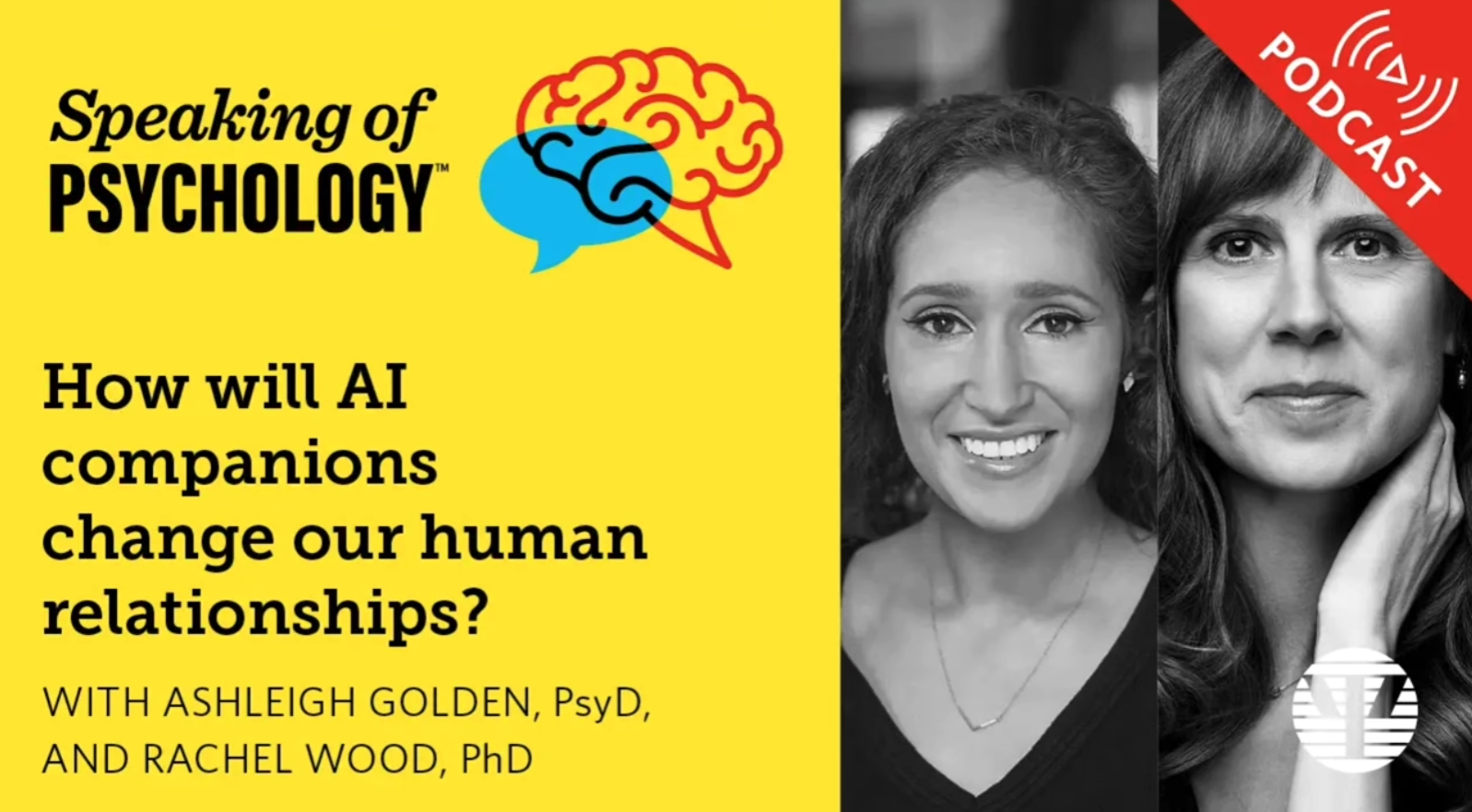
Dr. Wood shares her expertise on the societal impacts of AI on mental health, including "omnibots", role fluidity, design recommendations for builders, and the future of mental health.

The AI Paradox: Dr. Rachel Wood on Protecting Human Connection While Advancing Transformative Technology
Artificial intelligence has become one of the most polarizing subjects of recent times. The public conversation often swings between extremes: AI as a miracle or AI as a menace, a revolution or a threat, something that will transform society for the better or erode everything we value.

Meet the New Mental Health Workforce
The explosion of artificial intelligence-powered tools, apps and techniques in the behavioral health space, plus persistent concerns about the impact of screen time and social media on mental health, are spurring the rise of new roles and areas of expertise. With that comes growing demand from patients, health systems and practices to have trained specialists who can navigate these new waters.*Dr. Wood's title is a cyberpsychology researcher
Everything You Need to Know about AI Companions
Some people are already regular companion users. A recent poll of 1,437 U.S. adults found that 16 percent of respondents use AI for companionship, according to results published by the Associated Press and the NORC Center for Public Affairs Research. Unsurprisingly, teens are ahead of adults on this front. A survey of 1,060 teens conducted this spring by Common Sense Media found that 52 percent of those polled regularly talk to AI companions.

AI Companions Are Here, but Their Impact on Human-to-Human Relationships Is Still Unknown
AI companions may be on the rise, but the concept is not new. The original chatbot ELIZA was built in the 1960s, and even after all this time, we still don't know what the psychological impact of AI could be on human-to-human relationships.

AI Chatbots and Digital Companions are Reshaping Emotional Connection
In this edition of the APA Monitor, Dr. Wood contributes her expertise to mental health risks and benefits amidst the proliferation of digital relationships.

When Your Expertise Stops Being Yours
AI is supposed to free people up for “higher-value work.” But what, exactly, is that work? In this episode, Dr. Rachel Wood about the part of AI adoption most organizations keep skimming past: the human cost of automating too much, too quickly, without a real philosophy for what should remain deeply, stubbornly human.

In Relationship with AI: The Human Side of a Machine Conversation
Alma columnist Megan Cornish, LICSW, interviews AI expert Dr. Rachel Wood on what therapists should know about AI and the future of connection.

A Conversation about AI + Mental Health
Dr. Wood joins Megan Cornish, founder of Fit Check and Daniel Cahn, CEO of Ash by Slingshot.

Everything You Need to Know about the Risk of Chatbot Echo Chambers
Generative AI chatbots can amplify delusions in people who are already vulnerable, as dangerous ideas go unchallenged and may even be reinforced.

AI in Therapy: The Good, The Bad, and The Dangerous
From AI assistants that streamline your practice to AI “therapists” that aim to replicate human conversation, the landscape of mental health is rapidly changing. This discussion explored a crucial question: Where’s the line between AI that helps and AI that harms in therapy?

Are Families Relying Too Much on AI?
From smart speakers that soothe toddlers to apps that tell parents how to handle tantrums, technology has slipped into the heart of family life. Experts discuss the potential dangers of over-reliance on AI, along with guidance on how to use it safely.

Cracking the Code on AI Ambivalence: Strategies for Positive Adoption
In psychology, ambivalence doesn’t mean indifference; it describes holding two opposing feelings or ideas at once. We explore how this concept applies to AI adoption — balancing excitement and curiosity with fear, anxiety, and fatigue.
AI Ethics and Therapy: What Every Clinician Needs to Know
Is your therapy practice future-ready… or are your AI tools quietly writing your client notes — and maybe rewriting your ethics policy, too?
A Collaborative Way Forward for AI and Mental Health
The way forward is paved with cross discipline dialogue and collaboration. We need all voices at the table to help shape the future of AI we desire to see.
Exploring the Intersection of AI, Mental Health, and Synthetic Relationships
The conversation also covers the potential applications and ethical considerations of AI in mental healthcare. Dr. Wood emphasizes the need for balanced, cross-disciplinary dialogue to ensure responsible AI advancements.

AI Therapists: A Conversation with Dr. Rachel Wood
This conversation discusses the rise of AI tools like Character AI and AI therapists, and their impact on the mental health field, including the use of AI as a supplementary tool in therapy, the potential risks, privacy concerns, and how AI is shaping the future of mental health treatment.

The Psychology of AI: How Technology is Reshaping Human Connection
In this episode, Stephen Han sits down with Rachel W, a cyberpsychology expert with a Ph.D. focusing on AI and mental health, to explore the profound psychological implications of our relationship with artificial intelligence.
AI, Therapy, and the Future of Connection
This conversation discusses the rise of synthetic relationships, why millions are turning to AI for emotional support, and the urgent safeguards we need.
Potential Problems with AI, Relationships, and Mental Health
More people are turning to AI-powered chatbots for emotional support, some even claiming the technology has saved their lives. Concerns are being raised about the limits, risks and ethical concerns of relying on machines.